
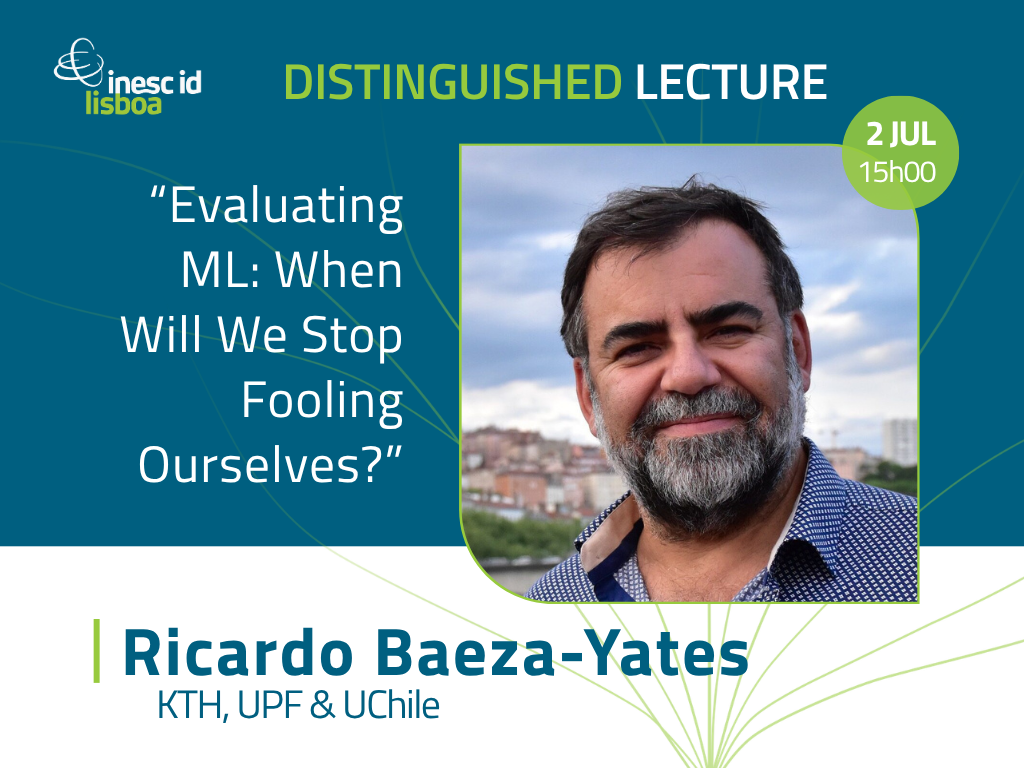
INESC-ID Distinguished Lecture: Professor Ricardo Baeza-Yates on “Evaluating ML: When Will We Stop Fooling Ourselves?”
For the second edition of the INESC-ID Distinguished Lecture series, we will welcome Ricardo Baeza-Yates from the KTH Royal Institute of Technology, Universitat Pompeu Fabra and University of Chile for a talk titled “Evaluating ML: When Will We Stop Fooling Ourselves?”.
Date & Time: 2 July, 15h00
Location: Room PA1 at Instituto Superior Técnico
Abstract: “ML Evaluation is usually based on an average measure of success such as accuracy. This kind of evaluation has several drawbacks: (1) the model works well for easy instances but badly for difficult ones, but the actual real distribution is usually not known; (2) this assumes that all errors have the same impact, which is almost never true; and (3) optimizing success does not minimize critical errors. In this presentation we discuss these problems and give some solutions that address them.”
Bio: “Ricardo Baeza-Yates is a part-time WASP Professor at KTH Royal Institute of Technology in Stockholm, as well as part-time professor at the departments of Engineering of Universitat Pompeu Fabra in Barcelona and Computing Science of University of Chile in Santiago. Before, he has been Director of Research at the Institute for Experiential AI of Northeastern University in its Silicon Valley campus (2021-25) and VP of Research at Yahoo Labs, based first in Barcelona, Spain, and later in Sunnyvale, California (2006-16). He is a world expert in responsible AI and member of AI technology committees at GPAI/OCDE, ACM and IEEE.
He is co-author of the best-seller Modern Information Retrieval textbook published by Addison-Wesley in 1999 and 2011 (2nd ed), that won the ASIST 2012 Book of the Year award. In 2009 he was named ACM Fellow and in 2011 IEEE Fellow. He has won national scientific awards in Chile (2024) and Spain (2018), among other accolades and distinctions. He obtained a Ph.D. in CS from the University of Waterloo, Canada, and his areas of expertise are responsible AI, web search and data mining plus data science and algorithms in general.”
About INESC-ID
INESC-ID, “Instituto de Engenharia de Sistemas e Computadores: Investigação e Desenvolvimento em Lisboa” is a Research and Development and Innovation Organization (R&D+i) in the fields of Computer Science and Electrical and Computer Engineering. INESC-ID mission is to produce added value to people and society, supporting the response of public policies to scientific, health, environmental, cultural, social, economic and political challenges. INESC-ID promotes cooperation between academia and industry by addressing research on daily life issues, such as healthcare, space, mobility, agri-food, industry 4.0, and smart grids. This high level of knowledge transfer is achieved through both competitive research projects and direct contracted research. Public and private entities have therefore access to a pool of knowledge, resources and services provided through the unique competencies available at the institution.
INESC-ID is supported by: