1st PhD Symposium bringing INESC-ID, FH Münster and Fraunhofer SIT together
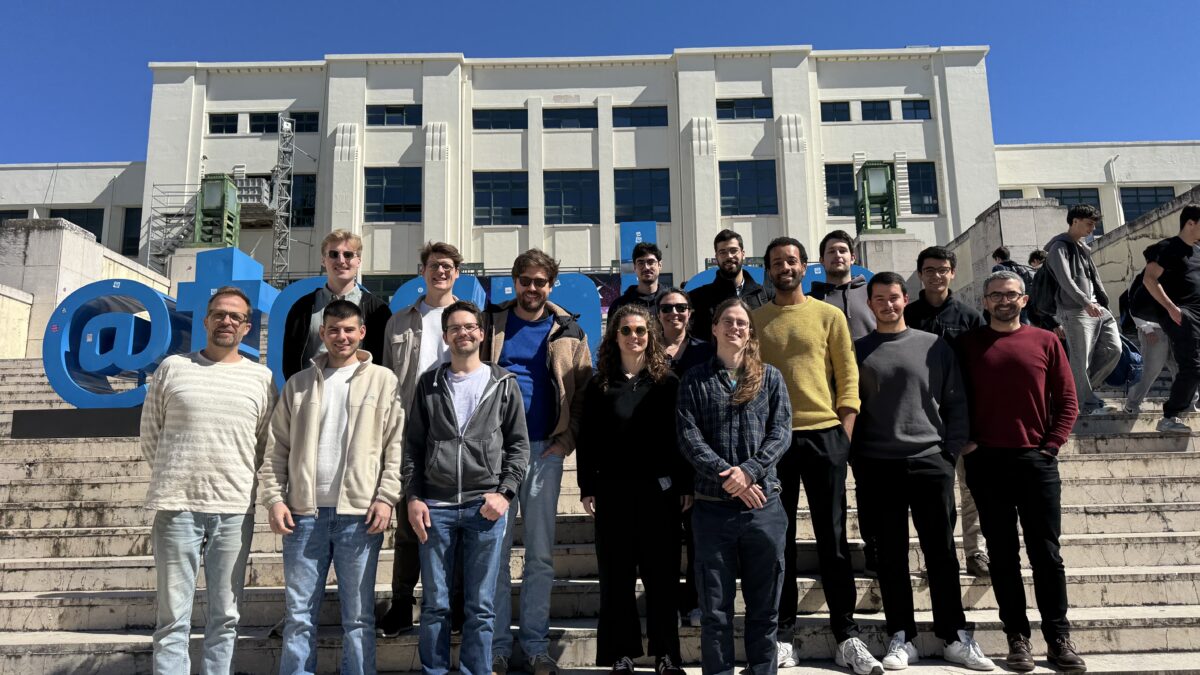
Last week, from 11 to 13 March, the auditorium of INESC-ID was the stage for the first PhD Symposium between INESC-ID, Fachhochschule Münster (FH Münster) and Fraunhofer Institute for Secure Information Technology (Fraunhofer SIT).
About 20 researchers and PhD students from the three institutes came together to discuss their current research, and for three days full of valuable talks and hands-on workshops.
From an introduction to post-quantum cryptography to the academic peer-review process, participants had the opportunity to explore a wide range of topics in an event that not only contributed to the capacity building of our students and researchers, but also to foster contact and collaboration among the institutes.
The three-day programme brought together presentations on topics ranging from cryptographic vulnerabilities and post-quantum cryptography to network security, AI-assisted threat detection, and secure systems design. Hands-on workshops complemented the talks, giving participants the opportunity to develop practical skills in areas such as user studies in security research and advanced uses of large language models.
Day 1:
- Bernardo Ribeiro: “Detecting Denial-of-Wallet Vulnerabilities in Serverless Applications”
- Samson Umezulike: “We’re rich! Breaking digital signatures in widely used systems”
- Samson Umezulike: “Introduction to Lattice attacks”
- Hülya Evkan: “Gentle introduction to PQC and MQ problems”
- João Aragonez: “A Streaming Framework for Large-Scale ISP Security Traffic Analysis”
- Miguel Lourenço: “Fast and Secure System Call Interception with SJailer”
- Marius Brockhoff: “Resilient digital communications in hospitals during crisis”
- Marius Brockhoff: “A case study for performing user studies in security research”
Day 2:
- Jonas Kaspereit: “Advanced usage of LLMs”
- Jonas Kaspereit: “Assisting security analysts in Security Operation Centers with LLMs”
- João Figueiredo: “AI-Driven Voice Phishing at Scale: Measuring Real-World Effectiveness and Designing Mobile Defenses”
- Nico Brüggemann: “The security of networked medical IT systems”
- João Veríssimo: “A Runtime for High-Speed Network Security and Privacy Enforcement”
- Leander Schröder: “Compression Attacks on TLS-encrypted IMAP”
Day 3:
- Gurur Öndarö: “Analyzing the security of the S/MIME ecosystem”
- Leonie Wolff: “Cryptographic agility”
- Fabian Ising: “A deep-dive into the academic peer-review process”
—
© 2026 INESC-ID. When sharing this article, credit INESC-ID with a link to the original source.
© Image: 2026 INESC-ID