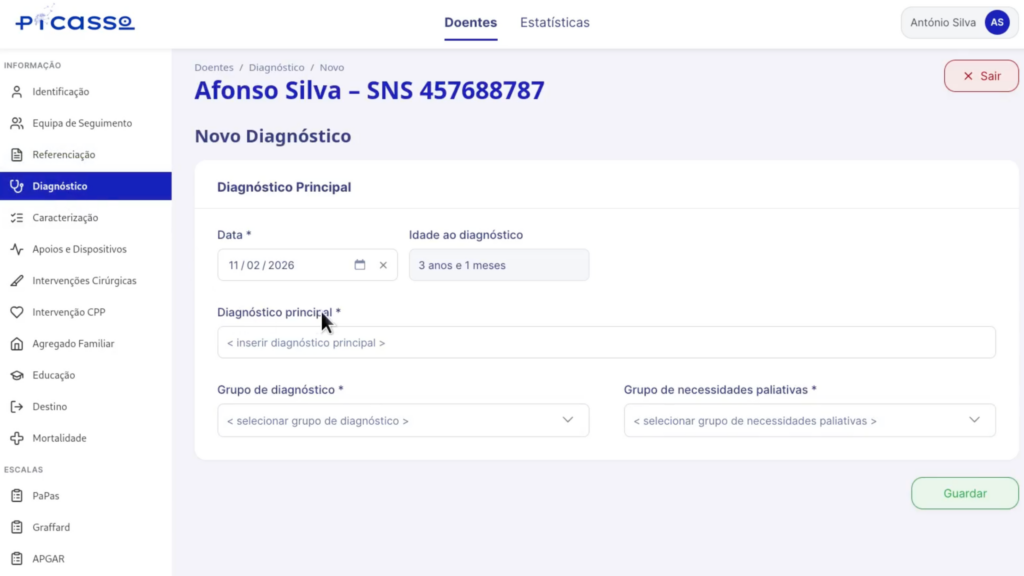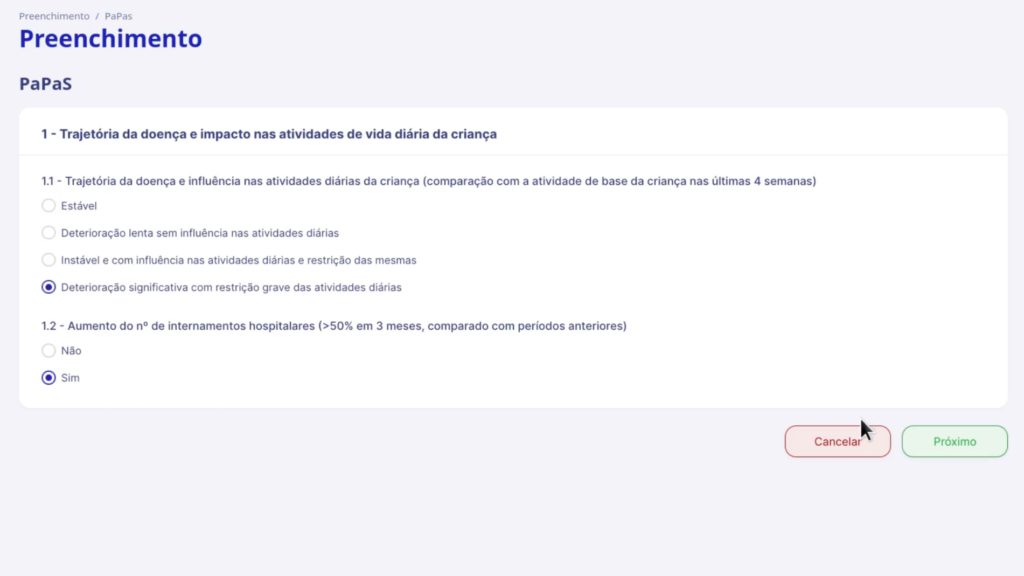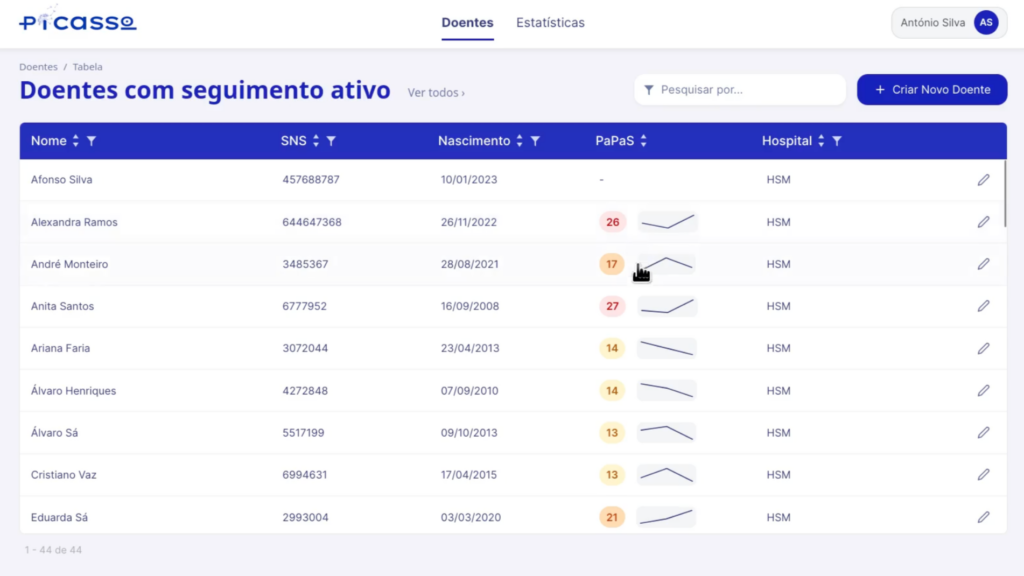
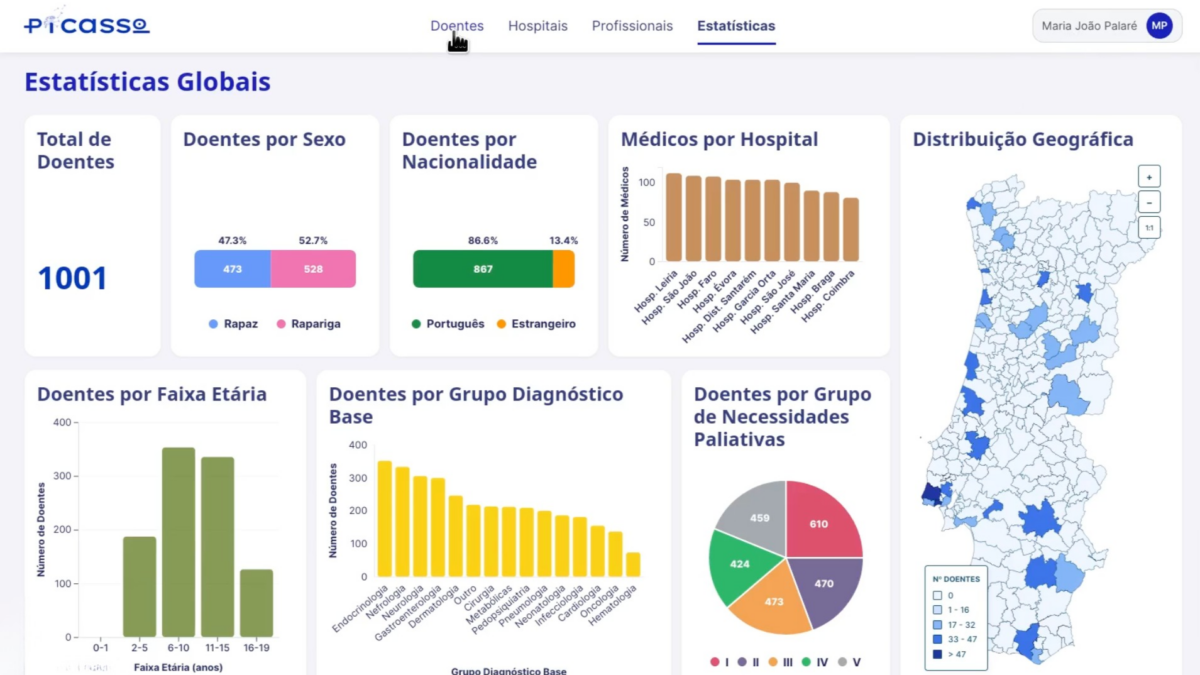
Dashboard from PiCaSSo showing global aggregated statistics and visualisations for the patients. Data shown is synthetic and used for demonstration purposes only. © 2026 INESC-ID
No longer invisible: PiCaSSo brings pediatric palliative care data to Portugal’s hospitals
In Portugal, 7,828 children require palliative care. Their clinical data still lives in Excel spreadsheets, scattered across doctors and hospitals. Maria João Palaré, a specialist at Hospital de Santa Maria, decided it was time to change that.
“In February 2024, we were contacted by a pediatric palliative care physician from Hospital de Santa Maria about a need she had,” says Helena Galhardas, researcher at INESC-ID, on the origins of the PiCaSSo project (Pediatric Palliative Care Support System).
The WHO estimates that around 21 million children and adolescents worldwide require pediatric palliative care. Portugal is one of the few countries with services considered adequate, advancing from the basic to the highest level on the international scale between 2013 and 2018. But understanding these patients and planning care at a national scale requires a structured, integrated data system across hospitals, something Portugal still does not have.
This was the challenge behind the project, funded by FCT and concluded in January 2026. Helena Galhardas and Pedro Monteiro led the team, with the collaboration of senior researchers Daniel Gonçalves and David R. Matos, all from INESC-ID and faculty at Instituto Superior Técnico, and five Master’s students, working closely with Maria João Palaré.
In just 11 months, the team built a user-friendly digital platform, accessible through a standard browser, integrating the PaPaS Scale (Pediatric Palliative Screening Scale), questionnaire, recently validated for the Portuguese version, which allows the early identification of children with complex chronic diseases and determination of the type of care and support required. In day-to-day consultations, the platform will allow clinicians to record and track each patient’s progression over time, visualise statistics by hospital or at a national level, and migrate data previously collected in Excel directly into the new system.
The tool is awaiting the signing of a formal agreement between INESC-ID and the Unidade Local de Saúde de Santa Maria (ULSSM), before entering production and being tested in a real clinical setting. In February 2026, Helena Galhardas publicly presented the PiCaSSo project at the 31st Pediatrics Symposium of Hospital de Santa Maria whose theme this year was “One Health. Uma só Pediatria.”
“Pediatric palliative care physicians from hospitals across the country have shown great interest in using the platform and already have authorisation from their respective Ethics Committees to participate in a multicentre study,” reveals Helena Galhardas.
The idea that children and young people may need palliative care is something society prefers not to see. PiCaSSo was built precisely so that no physician has to work in the dark.
The PiCaSSo project (ref. 2024.07300.IACDC) was funded by Fundação para a Ciência e a Tecnologia (FCT) under the Recovery and Resilience Plan (PRR). It ran from March 2025 to January 2026, with a budget of €98,266.79. PI (INESC-ID): Helena Galhardas and Pedro Monteiro. Clinical partner: Unidade Local de Saúde de Santa Maria (ULSSM).
PiCaSSo demonstration video: here
More information: picasso.inesc-id.pt
—
© 2026 INESC-ID. All rights reserved. When sharing this article, credit INESC-ID with a link to the original source. Adaptations require prior written permission.
Images: © 2026 PiCaSSo / INESC-ID